A five-axis PTP center built around one job: complete wooden doors
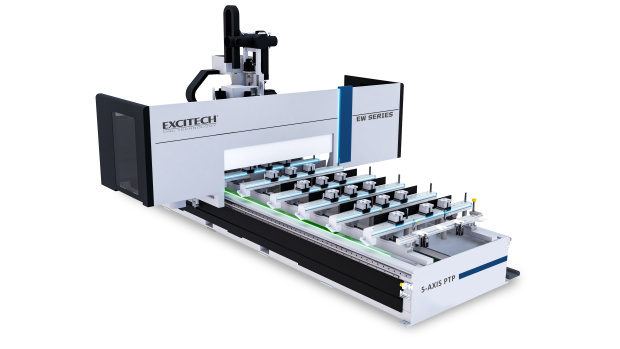
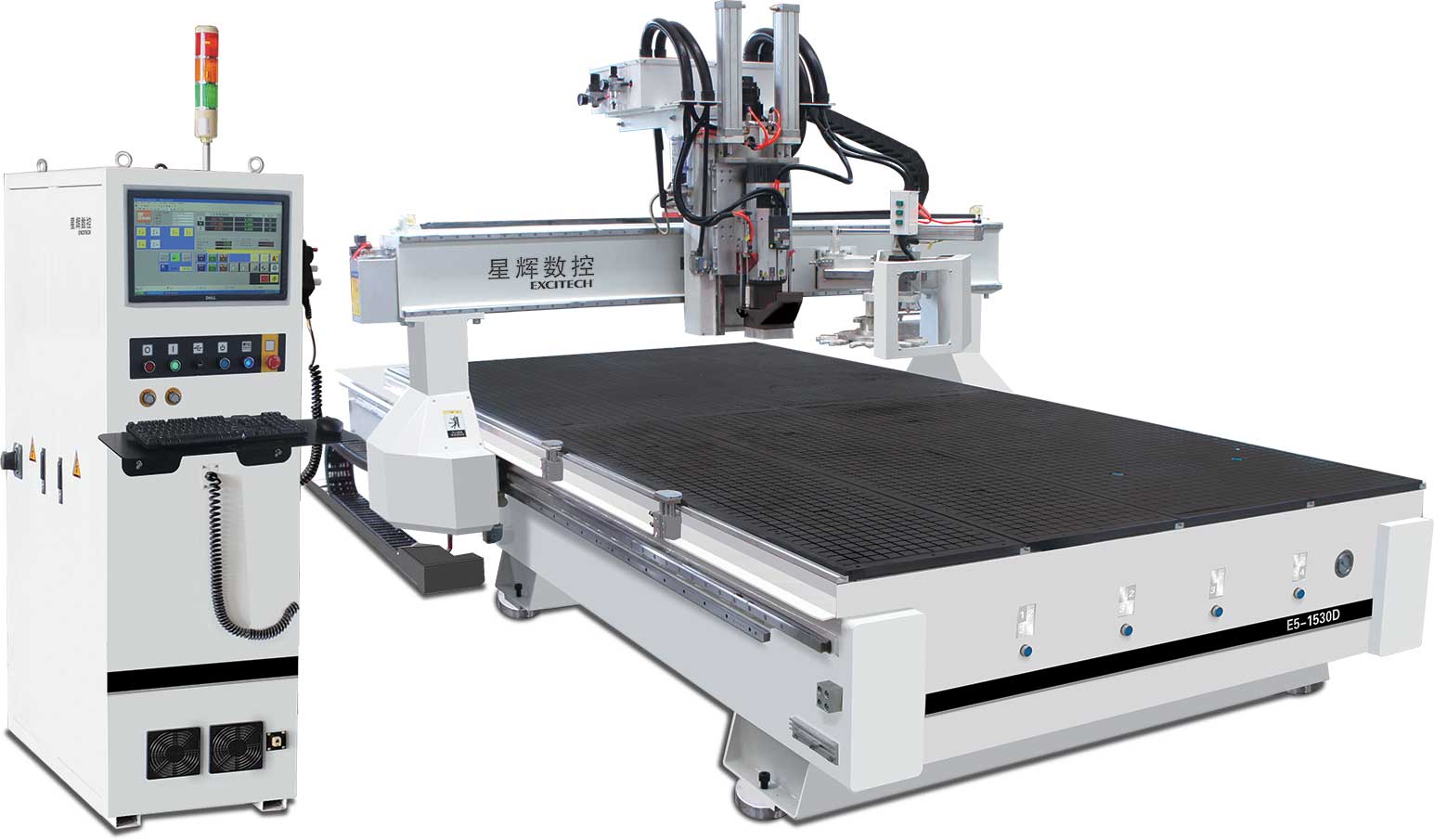
The Excitech EW-1643 is a five-axis PTP (pod-and-rail) CNC machining center designed for manufacturers who process solid wood doors, door components and oversized panels in a single setup. Unlike a flat-table nesting machine, the EW-1643 uses a raised pod-and-rail table, which gives the machining head free access to all six faces of a workpiece and lets operators clamp tall, narrow parts — door stiles, rails, frames and thick solid timber — without building a custom fixture.
The model code is not random. “1643” describes the working envelope in centimetres: 1600 mm across the gantry by 4300 mm of longitudinal travel. That 4.3-metre stroke is the reason this machine is usually specified by door plants, staircase manufacturers and joinery workshops rather than by panel-only furniture factories.
Working area and table architecture
The table measures 4300 × 1630 mm and is divided into two independent working zones. Each zone has its own console, so one operator can load and unload one side while the machine is still cutting on the other. For a door line, that means the cycle never really stops: the machine finishes a stile or a frame, the operator swaps parts, and the head moves straight to the second zone.
The table surface itself is a European-made SCHMALZ pod-and-rail system. Vacuum pods are positioned on rails according to the part being machined, and an LED indicator shows the operator where the cups sit for the most common door and frame sizes. That detail matters more than it looks: on a five-axis machine, the position of the clamping point determines whether the cutter can reach the workpiece edge without hitting a pod.
Vacuum is supplied by a German Becker dry-running pump rated at 5.5 kW with 250 m³/h of suction capacity. Dry-running pumps are the standard choice for wood dust environments because they need no oil separator and tolerate the fine MDF and solid-wood dust that would contaminate a lubricated rotary-vane pump.
Machining head, drilling bank and tool changing
The five-axis head carries an Italian Hiteco spindle rated at 13.5 kW with water cooling. Water cooling keeps thermal drift low during long door cycles, which is what protects the accuracy of hinge and lock recesses across a full shift.
Behind the spindle sits a complete drilling bank: 12 vertical spindles, 4 horizontal spindles and one combined drilling/sawing unit. In practice, this means hinge bores, lock cases, dowel holes, handle holes and the saw cut for a door slot can all be produced without changing a single tool. On a traditional three-axis router, each of those operations costs a tool change; here they cost seconds.
Tool changing is handled by three separate magazines. A 16-position carousel with its own servo motor covers the main cutting tools. A 10-position linear changer at the rear of the machine holds additional tooling, and a 4-position linear changer at the front is dedicated to saw blades. The rear linear changer is pneumatically actuated, so tool selection happens in parallel with machining rather than interrupting it.
Motion system and feed rates
X and Y axes run on helical rack-and-pinion drives, the correct choice for a 4.3-metre stroke: rack and pinion transfers force without the whip and length limitations of a ball screw over that distance. The Z axis uses a ball screw, where short-stroke precision matters more than travel. The machine’s rapid traverse speed is stated at 40 m/min.
Control, drives and electrical architecture
The controller is an Italian OSAI unit. Axis motion is driven by YASKAWA servo motors and drives from Japan, a combination that is well understood by service engineers across Europe and the Middle East. Wiring runs through Igus flexible cable, relays and switches are Siemens, and the electrical cabinet is ventilated to keep drive electronics within temperature limits in hot workshops.
Two details in the electrical design are worth noting for maintenance planning. First, the cable chain is sealed and dust-protected, which extends the life of the drag chain in a dusty environment. Second, heavy-duty plugs and connectors are used throughout, so a failed drive or sensor can be replaced without rewiring a loom. An automatic lubrication system keeps the guides and racks supplied without manual intervention.
Safety, dust management and access
A large protective cover surrounds the gantry, supplemented by a safety fence on three sides and a safety light curtain on the fourth. Dust and chips are removed by a belt-type extraction system. For CE compliance, this arrangement is the standard configuration for a machine of this class, and it also reduces the cleaning load on the operator.
Where the EW-1643 pays for itself
The business case for this machine is cycle time on complex door work. Every operation that a three-axis router performs with a tool change — hinge recess, lock pocket, handle bore, slot cut, edge profile — is performed here with the head already positioned. For a plant producing solid wood doors in volume, the practical result is fewer setups, fewer re-clamping errors and a shorter route from raw stile to finished door.
It is also a machine for parts that do not fit a flat table. Because the pod-and-rail system holds workpieces vertically on their faces, thick timber and assembled frames can be machined on all sides. That is the specific capability a nesting machine cannot offer.
Specifications to confirm before ordering
The EW-1643 quotation does not state the A and C axis rotation ranges, the axis servo motor ratings, spindle speed, power supply voltage and frequency, or compressed-air pressure and consumption. It also does not list a priced options schedule, and the vacuum table’s exact cup and rail count is not specified. These values should be confirmed in writing with the supplier before any published specification is finalised.





Reviews
There are no reviews yet.